

Online safety · Content moderation · Platform governance

SAFE-netOnline Safety and Moderation in Digital Platforms

Project support
Programme
STARS@UNIPD Consolidator Grant
Funding
EUR 94,000
Period
2026–2028
Role
Principal investigator

§ I — Research agenda

When should platforms and regulators intervene against harmful content?

The project asks when platforms can be expected to tackle harmful content on their own, and when regulation is needed to correct weak or distorted incentives.

— 01

Platform incentives

Why do platforms intervene on content moderation, age assurance, and platform governance only in some circumstances?

— 02

Regulatory effectiveness

When do the EU Digital Services Act, the UK Online Safety Act, US age-verification laws, and liability regimes matter?

  • Interprets the EU Digital Services Act, the UK Online Safety Act, US age-verification laws, and platform-liability regimes through a common framework.
  • Combines theory with empirical analysis of actual moderation practices and policy interventions using public and proprietary data.
  • Empirical work includes age verification on adult platforms and ex-post analyses of platform interventions, with room for structural counterfactual analysis.
§ II — Research outputs

From age verification to creator incentives.

The project currently centres on one main working paper, with related work and downstream publications listed below.

Working paper

Are You 18? Age Verification and Adult-only Consumption in the US

with Saharsh Agarwal, Uttara M. Ananthakrishnan, Matthew Mitchell, Martin Quinn, and Carlo Reggiani

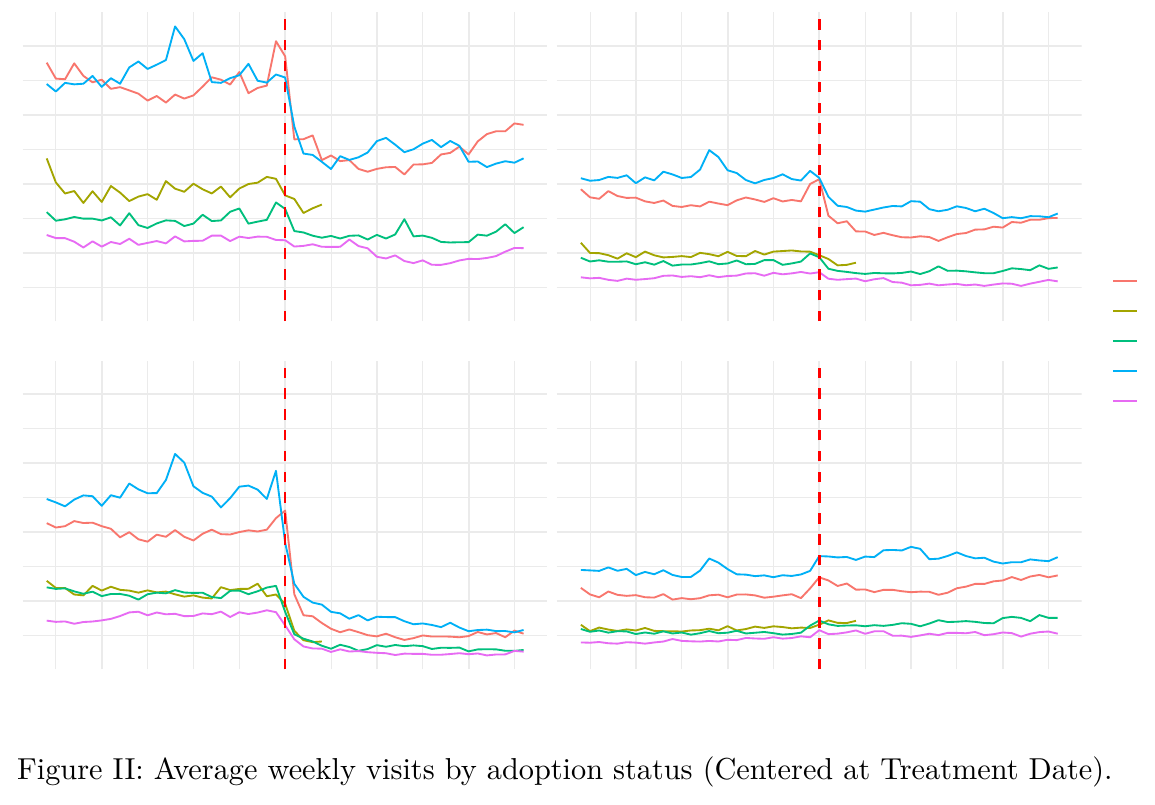
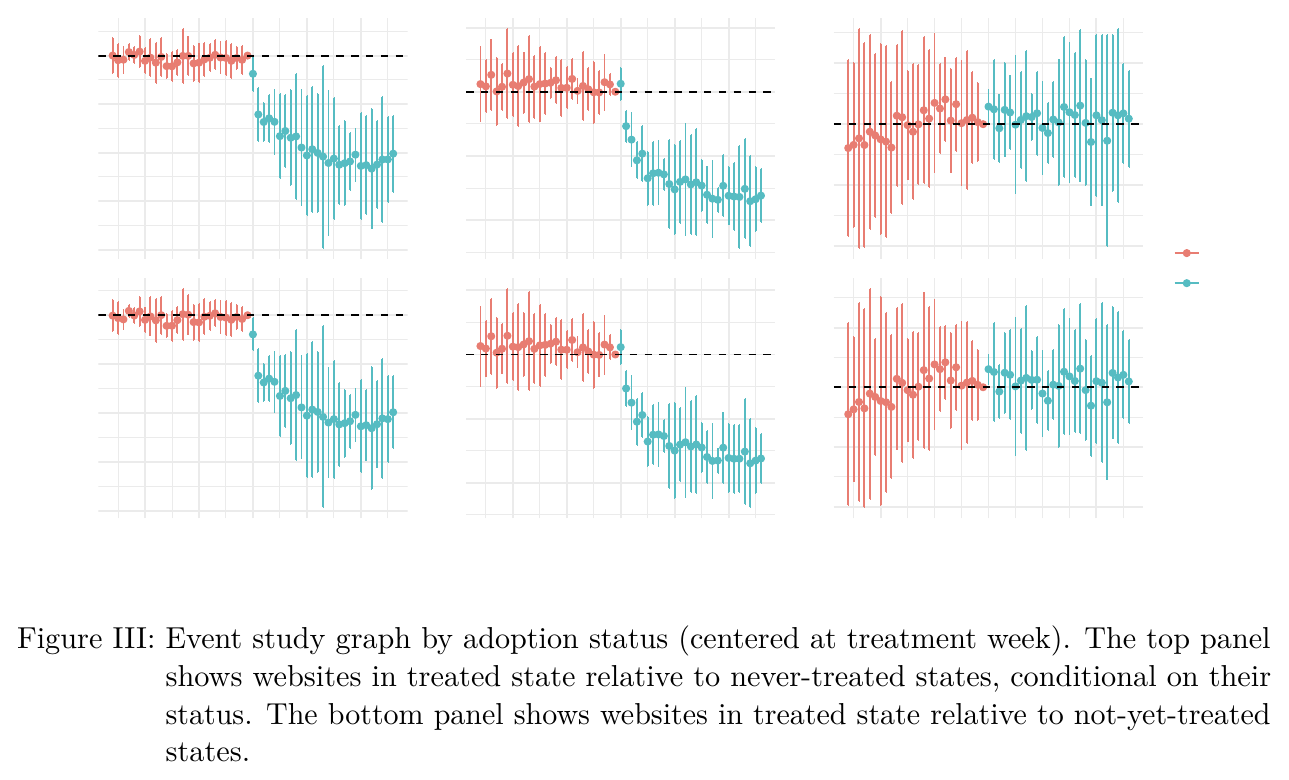
Several U.S. states now require age verification to access online pornography. Using domain–state–week traffic for the major adult platforms across fifteen states, the paper estimates the causal effect of these laws with a staggered difference-in-differences design.

Platforms that introduced age gates lost a large share of visits, and platforms that exited blocked states lost the most, while two large ungated sites (XVideos, XNXX) gained 35–40% — evidence of substantial cross-platform substitution when enforcement is uneven. Registration- and payment-based platforms (e.g., OnlyFans, Stripchat) changed little, since their users were already authenticated.

Two figures illustrate the main result; the red dashed line marks the week each state's law takes effect. Hover over a figure to zoom in.

Average weekly visits to adult domains by adoption status, centred at the treatment date
Figure II — Descriptive trends. Average weekly visits centred on the implementation date. Traffic to sites that adopt age gates or exit the state falls sharply at the cut-off, while non-adopting sites barely move.
Event-study estimates of age-verification laws on weekly visits by adoption status
Figure III — Event study. Estimated effect by week relative to enforcement. Pre-trends are flat (no anticipation), and the drop is immediate and persistent once the law is in force.

Publication: working paper in PDF

Work in progress

Creators under (Moderation) Pressure

with Martin Quinn

Ongoing project on how content-moderation policies and enforcement pressure shape creators' incentives, content choices, and participation on online platforms.

← Back to grants